
 Feefo 5.0* 1000+ reviews
 UK wide delivery on all products
 Products can be fully calibrated & certified
 Service & repairs at competitive prices
 Find a better price and we will try and beat it




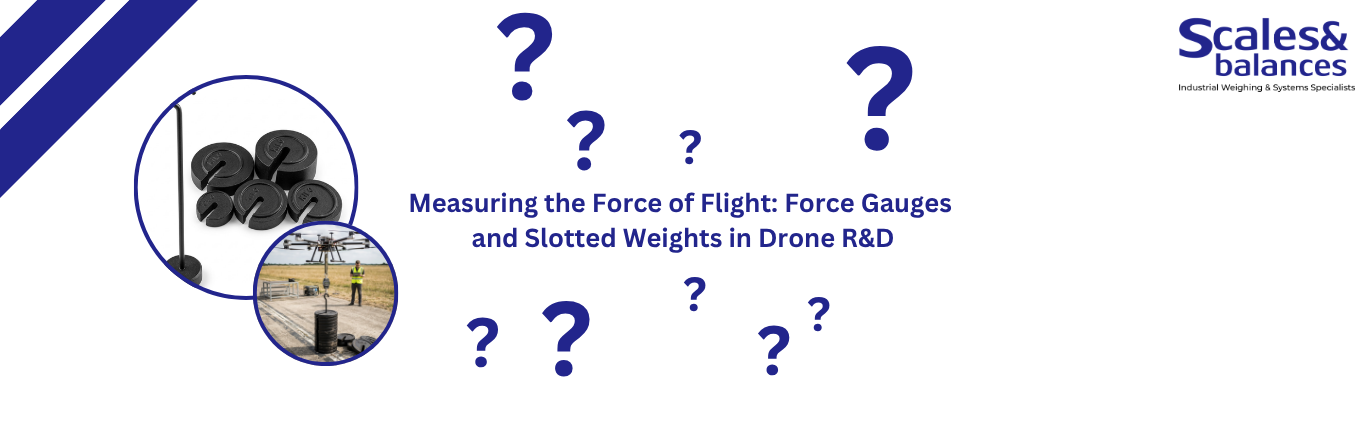)
Measuring the Force of Flight: Force Gauges and Slotted Weights in Drone R&D
In drone development, performance usually comes down to two things: how much thrust you can generate and how efficiently you can do it. Whether it’s for commercial UAVs or more specialised defence projects, getting accurate data on motors and propellers is a key part of the process.
At Scales and Balances, part of the Brash Group, we supply the tools that support this kind of testing. From digital force gauges to physical calibration weights, the aim is simple: give engineers reliable data they can actually trust.
The Role of a Thrust Stand in Drone Testing
To understand how a motor and propeller setup performs, engineers typically build a thrust stand. This allows them to measure how much force is being generated under controlled conditions.
While basic load cells can do the job, more detailed testing often calls for a higher-spec digital force gauge. These can capture small fluctuations in thrust and vibration, which are easy to miss but important when refining performance.
With the right setup, you can build a clear picture of how a system behaves:
- Maximum thrust
Understanding the upper limits of lift. - Efficiency at different throttle levels
Looking at how much thrust is produced relative to power input. - Propeller comparison
Testing different propeller types on the same motor to find the best match.
Why Calibration Still Matters
It’s easy to rely on digital readings, but they’re only useful if they’re accurate. Over time, sensors can drift due to temperature changes or repeated use, which can introduce small errors that add up.
That’s where physical calibration comes in.
Hanger and slotted weights are still widely used in drone labs to verify force measurements. We supply these in recognised accuracy classes such as M1. These can be in Kilograms (kg) or Newtons (n), giving engineers a simple way to check their equipment before and during testing or to check the carry capacity of a early stage prototype.
In practice, this might involve:
- Pre-test checks
Applying known weights to confirm the force gauge is reading correctly. - Step-by-step verification
Testing across a range of loads to make sure readings stay consistent, not just at one point.
A Practical Example from UK Drone Development
One of our customers, an independent UK drone engineer working towards defence applications, uses this approach as part of their daily testing routine.
Before running any propulsion tests, they use slotted weights to verify how much their drone can carry.
When you’re working towards safety-critical applications or procurement standards, that level of confidence is essential.
Keeping Measurements Reliable
In drone R&D, small inaccuracies can lead to bigger problems down the line, especially when scaling up designs or moving towards real-world deployment.
Using a combination of digital force measurement and physical calibration helps avoid that. It gives you both the detail you need for development and the traceability required for compliance.
Explore Related Solutions
-
Digital Force Gauges: High-precision instruments for thrust stands, tension, and compression testing.
-
Slotted and Hanger Weights: Traceable M1 weights for routine calibration and sensor verification.
-
Aerospace, Motorsport, and Drone Weighing: Our full range of component weighing, moisture analysis, and ATEX safety equipment.