
 Feefo 5.0* 1000+ reviews
 UK wide delivery on all products
 Products can be fully calibrated & certified
 Service & repairs at competitive prices
 Find a better price and we will try and beat it
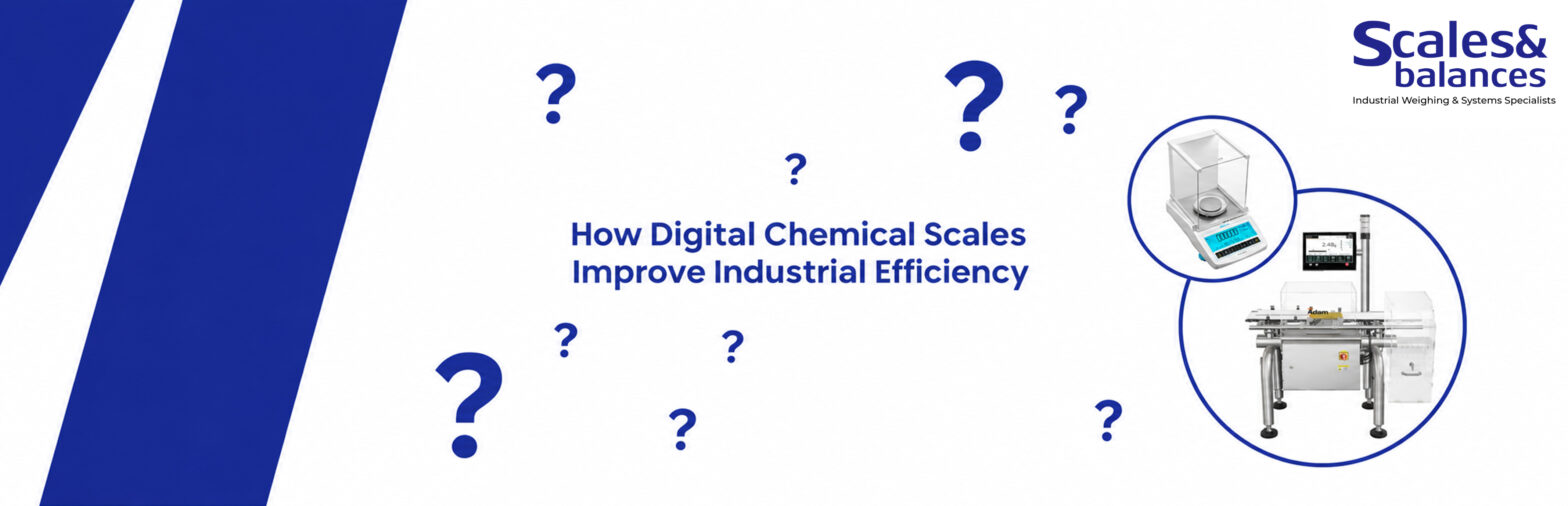
How Digital Chemical Scales Improve Industrial Efficiency
In industrial laboratory and production environments, where precision is typically non-negotiable, accurate weighing underpins almost every process. From chemical formulation and quality control to research and batch validation, even minor measurement errors can have costly consequences. Chemical scales, particularly modern digital laboratory models, provide the accuracy, stability and data integration required to support industrial efficiency at every stage of operation.
In this introductory guide, we will explore how chemical scales improve industrial efficiency, reduce waste, support compliance and enhance overall laboratory performance.
- What Do Digital Chemical Scales Do?
- Who Uses Digital Chemical Scales?
- Improved Compliance & Productivity With Chemical Scales
- Choosing the Right Chemical Scales for Your Industrial Laboratory
- Purchasing Digital Chemical Scales
What Do Digital Chemical Scales Do?
At the heart of every laboratory operation is measurement accuracy. Digital chemical scales are designed to deliver highly precise readings, often to multiple decimal places, ensuring formulations remain consistent across repeated batches. Choosing the right equipment minimises this risk. Stable, repeatable readings, even when weighing very small sample sizes, help users obtain dependable measurements quickly. When laboratory technicians can trust their chemical scales to produce reliable results every time, processes flow more smoothly. Fewer errors translate directly into improved productivity and reduced material waste.
Who Uses Digital Chemical Scales?
Accurate digital chemical scales are used by a wide variety of analysts, scientists, testers and production workers across industrial workspaces. If precision is fundamentally important to safe and consistent outcomes, you’ll see chemical scales at work. Pharmaceutical manufacturers rely heavily on them for formulation, active ingredient dosing and batch validation. Chemical production facilities also depend on laboratory-grade digital chemical scales during research, pilot production and full-scale manufacturing. Research chemists use them to develop and refine formulations, while production teams apply the same precision principles when scaling recipes for commercial output.
In food and beverage laboratories, digital chemical scales support ingredient testing, additive verification and shelf-life research. Environmental testing laboratories use chemical scales to prepare samples for analysis, ensuring accurate measurement before chemical or spectrometric testing takes place. Academic institutions and private research organisations also make extensive use of digital chemical scales in teaching laboratories and experimental research settings. Accurate weighing allows students and researchers to replicate results and maintain experimental integrity.
Across all of these sectors, digital chemical scales serve a common purpose: delivering reliable, repeatable measurement that underpins safe production, scientific accuracy and regulatory compliance.
Improved Compliance & Productivity With Chemical Scales
Industrial laboratories often operate under strict regulatory frameworks, particularly in sectors such as pharmaceuticals, food production and hazardous chemical handling. Compliance requires accurate documentation, calibration control and audit-ready record keeping. Digital chemical scales support this compliance by offering accurate, repeatable weight measurement. Traceability is essential when investigating deviations or validating production batches. Reliable chemical scales often help by providing a consistent measurement history. In this way, digital chemical scales reduce uncertainty and strengthen regulatory adherence.
Compliance is often vital, but it doesn’t necessarily guarantee the efficiency of your operation. Accurate weight measurement at each phase of industrial chemical production, from product formulation through quality assurance to final batch verification, can go a long way towards minimising waste and loss.
Beyond routine production tasks, chemical scales are essential tools in research environments. In analytical laboratories, precise measurement supports experimental accuracy and reproducibility. Small variations in sample preparation can significantly affect results, and again contribute towards productivity.
Choosing the Right Chemical Scales for Your Industrial Laboratory
Selecting the appropriate chemical scales for your application is essential if you are going to pick equipment to enhance productivity. Key considerations include readability, capacity range, calibration method and environmental conditions within the laboratory.
Analytical chemical scales with higher precision are ideal for research and formulation work, while precision balances with larger capacities may better suit industrial production tasks. Features such as draft shields, internal calibration and connectivity options should be evaluated in line with operational requirements.
Discussing your laboratory setup with an experienced supplier can help ensure your chosen chemical scales align with workflow demands and compliance obligations.
Purchasing Digital Chemical Scales
Digital chemical scales are far more than simple weighing instruments; they often sit at the centre of efficient laboratory and industrial operations. Every formulation, test sample or batch adjustment depends on accurate measurement, and without dependable chemical scales, even well-designed processes can fail. By delivering precise, repeatable readings, digital chemical scales reduce variability and limit costly errors. Integration with digital systems accelerates weighing tasks, minimises human intervention and strengthens documentation. It is easy to see how a wireless chemical scale, for example, reporting data automatically, directly contributes to productivity.
In all industrial sectors, meaningful efficiency improvements arise from refining processes that may appear routine but are fundamentally important. Precise weighing is one such process. Small inaccuracies, repeated across multiple batches, can result in material waste, rework or production delays. When laboratories invest in high-quality chemical scales and embed them into everyday procedures, they establish a stable operational foundation for productivity gains.