
 Feefo 5.0* 1000+ reviews
 UK wide delivery on all products
 Products can be fully calibrated & certified
 Service & repairs at competitive prices
 Find a better price and we will try and beat it
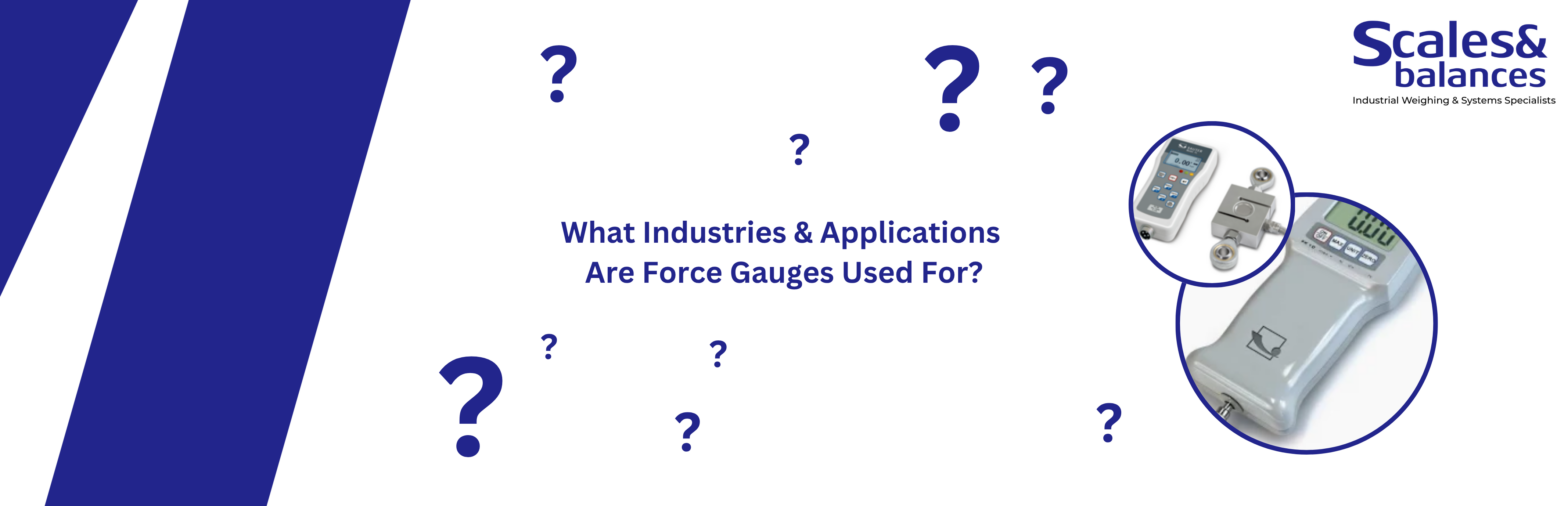
What Industries & Applications Are Force Gauges Used For?
Force gauges, sometimes known as force meters or push-pull gauges, are precise measuring instruments used to quantify the magnitude of tension (pulling) or compression (pushing) forces being applied on or through an object. Force gauges prove useful in all kinds of industrial environments, tackling a wide range of manufacturing, research and development, safety management, and quality control tasks. They vary in type and capacity, but they all record critical data.
If you’ve been tasked with investigating product strength and reliability, our introductory guide to the force gauges available to industry has been written to help.
- What Is A Force Gauge?
- Who Typically Uses Force Gauges?
- Force Gauges In Industry
- Typical Force Gauge Applications
- Types Of Force Gauge
- Purchasing A Force Gauge
What Is A Force Gauge?
A force gauge is a device that records the physical forces applied when an object or material is compressed or put under tension. They can be handheld or mounted on a test rig or stand. Force gauges convert physical force into a readable measurement displayed either digitally or mechanically.
Most force gauges capture real-time data, allowing users to monitor live force readings during testing. This is particularly useful for assessing product strength and evaluating material performance.
Force gauges are available in a wide range of capacities, from lightweight instruments used in laboratory testing to heavy-duty devices capable of measuring substantial loads in industrial environments. Many models also allow measurements to be displayed in multiple units, such as newtons, kilograms-force, or pounds-force, providing flexibility across international applications.
By delivering accurate, repeatable data, force gauges help teams make informed decisions about product design, safety, and performance.
Who Typically Uses Force Gauges?
Any professional who needs to measure a push or pull force will use a force gauge. Engineers rely on them during research and development, for example, where they can test component strength and durability. Those responsible for quality assurance use force gauges to verify acceptable product performance. In the packaging and consumer goods industries, force measurement is a vital step in checking that seals, closures, and moving parts comply with required standards. Laboratories and testing facilities frequently use force gauges to analyse materials. Finally, maintenance teams and safety inspectors are likely to use force gauges to check on-site systems and components such as cable tension.
Wherever they are used, force gauges and the reliable data they provide support safe and efficient working practices.
Force Gauges In Industry
Industrial engineers and technicians use force measurement to assess how materials respond to stress or strain. Force gauges support both innovation and routine quality checks, verifying the strength thresholds of products, materials and components. This is useful in all industries, but vital when safety or compliance is critical. You will often see accurate force meters at work in sectors such as oil & gas, aerospace, and construction.
Maintenance teams also use force gauges to record the tension in cables, springs, or mechanical systems, for example. This can reveal early signs of wear, preventing breakdowns and reducing downtime. Finally, force gauges also support compliance testing, helping businesses demonstrate that products meet industry and regulatory standards.
Typical Force Gauge Applications
Force gauges are used in a wide variety of applications, from packaging peel strength to construction cable safety checks. Tensile testing is common, for example. This describes the process of recording the strength of materials such as wires, fabrics, or plastic components by pulling them. The opposite, compression testing, is another frequent application. This allows engineers to assess how materials behave when pressure, or a push force, is applied.
In research and development and laboratory settings, force gauges support experimentation, analysis and innovation, helping scientists understand how different materials respond to physical forces.
These varied applications highlight the versatility of force gauges across industrial tasks. From everyday compliance checks to cutting-edge research and development, you’ll find a force gauge at work.
Types Of Force Gauge
There are numerous types of force gauges available in industry, each designed with a distinct set of capabilities to suit different force-measuring tasks. Entry-level hand-held force gauges, for example, typically feature straightforward mechanical components. Digital force gauges offer more advanced features and greater accuracy, and push-pull gauges are versatile, measuring both compression and tension forces. Heavy-duty mounted force gauges are often used alongside test stands to provide stability. Portable dynamometers support higher-capacity industrial tasks, including monitoring lifting and rigging operations. Choosing the right type of force gauge depends on a range of factors. It pays to have a clear understanding of your requirements before investigating your options.
Purchasing A Force Gauge
When purchasing a force gauge, it is important to start by identifying your specific testing requirements. Consider the range of forces you need to measure and the level of accuracy you require. Industrial environments may require rugged designs that can withstand regular handling, while laboratory settings may prioritise precision and advanced functionality. Connectivity features are increasingly important for businesses that need to record or analyse data, often taken remotely.
Working with a knowledgeable supplier can make a significant difference if you’re looking to invest in a force gauge. Expert advice helps ensure the equipment you choose aligns with your application, while calibration and after-sales support help maintain performance over time.
Force gauges are powerful tools for understanding how products and materials behave under stress. By investing in the right equipment, businesses can improve quality control, enhance safety, and support innovation across a wide range of industries and applications.